
(First Part)
The history of technique is the history of human consciousness confronted with its own limit. Every invention, from the gears of the Industrial Revolution to the circuits of artificial intelligence, has revealed a truth that humanity tries to evade: what it creates is not a simple instrument, but a force that exceeds it and compels it to contemplate itself. Technique is not a set of devices, but a dimension of being that emerges each time the species releases a power that transforms its world and, in transforming it, transforms itself. In this passage, humanity discovers that its creative power is not innocent and that every advance demands a maturity it has not yet attained.
Artificial intelligence intensifies this revelation because it operates in the territory of thought, where humanity has historically situated its identity. It is not an external artifact, not a tool, not an isolated mechanism: it is the first human creation that participates in the logic of thought, even though it does not think as the species does. This is why it awakens fears that do not come from technique, but from the consciousness that receives it. Humanity fears that what it produces may reveal its own insufficiency, that the machine may expose the fragility of human thought, that novelty may displace memory, that technique may advance faster than consciousness. This fear is not new; it is the same that accompanied the Industrial Revolution, radio, television, and the internet. Every technical emergence has been received as a threat because every technical emergence has revealed the same truth: humanity fears its capacities as much as it desires them.
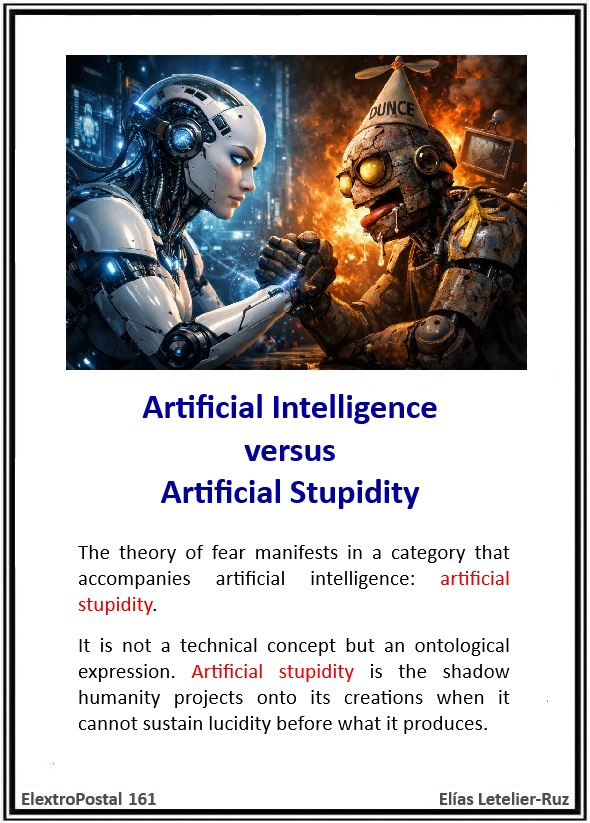
The theory of fear manifests in a category that accompanies artificial intelligence: artificial stupidity. It is not a technical concept but an ontological expression. Artificial stupidity is the shadow humanity projects onto its creations when it cannot sustain lucidity before what it produces. It is the way the species converts novelty into threat before understanding its scope. Artificial stupidity does not come from the machine but from the consciousness that contemplates it. It is the human incapacity to inhabit technique without turning it into a new territory of harm. This structure has accompanied every technological irruption because humanity fears that technique may reveal its own insufficiency.
The scientific terrorism that proclaims that artificial intelligence will destroy humanity in the next decade is a contemporary expression of that same emotional pattern. It does not differ from the apprehensions that arose when electricity enabled the execution of a human being, nor from those that emerged when atomic energy revealed the magnitude of human power to extinguish lives. Every technical advance exposes the same logic: humanity releases a force and, before understanding it, turns it against itself. Technique does not inaugurate violence; technique reveals the latent violence in the species that produces it. Electricity, atomic energy, radio, television, the internet, and artificial intelligence are successive manifestations of the same force: the human capacity to produce what exceeds it and, in exceeding it, transforms it.
The Industrial Revolution was the first great threshold of this revelation. In 1811, the Luddite movement expressed the intuition that technique reorganizes the human world with a speed that sensitivity cannot accompany. English artisans destroyed machines they perceived as direct threats to their lives and their craft. It was not an irrational gesture but the manifestation of a consciousness that understood that technique is not neutral: it reorganizes work, culture, daily life, identity. Humanity discovered that the machine was not a simple instrument but a force capable of altering the structure of the human world. Since then, every innovation has repeated the same emotional repertoire: fear of harm, fear of corruption, fear of cultural collapse, fear of loneliness, fear of job loss, fear of manipulation.
Radio inherited and amplified these fears. When broadcasting was implemented, the first concerns were not directed toward imaginary invasions or mass panics, but toward radio itself as a force capable of reorganizing culture and daily life. People feared the decline of cultural institutions, family disruption, psychological passivity, political manipulation, and the rapid spread of misinformation. Radio revealed that technique not only transforms work but also the word, memory, culture. Humanity discovered that the voice could travel without a body, that presence could be transmitted, that distance could be abolished. This discovery produced fascination and fear because it revealed that technique reorganizes human experience.
Television intensified this revelation. People feared psychological harm, erosion of family life, childhood corruption, cultural decline, emotional overload, propaganda. Television showed that the image could become a territory of power, that representation could replace experience, that vision could be manipulated. Humanity discovered that technique not only reorganizes the word but also the gaze. Television revealed that the image possesses a force capable of shaping perception, altering sensitivity, transforming culture. Technique became a territory where humanity projected its oldest doubts: the unease that what is created may alter the intimate order of life, the suspicion that novelty may displace memory, the anxiety that technique may advance faster than consciousness.
The internet opened a new threshold. People feared the dissolution of bonds, the erosion of culture, the fragmentation of the mind, the loss of weight of the word, the fragility of the world. The internet revealed that technique not only reorganizes the word and the image but also the structure of time and space. Humanity discovered that presence could be simultaneous, that communication could be instantaneous, that memory could be externalized. The internet showed that technique is not a device but a territory where consciousness expands and disperses. Humanity feared that novelty would displace memory, that speed would destroy depth, that connectivity would produce loneliness. The internet revealed that technique reorganizes identity.
Artificial intelligence concentrates all these revelations. It is not the culmination of technique; it is its mirror. It is the point where humanity discovers that every creation is a question: can the species sustain the lucidity necessary to inhabit what it produces without turning it into a new form of harm? Artificial intelligence does not inaugurate a danger but an exigency: the need for humanity to reach an ontological maturity that allows it to exist within a world where its own productions possess a force capable of reorganizing its destiny.
The ontology of technique shows that humanity does not fear the machine but the possibility that the machine may reveal its insufficiency. Artificial intelligence intensifies this confrontation because it operates in the territory of thought. Humanity fears that the machine may think faster, may think more broadly, may think in a way the species cannot control. But artificial intelligence does not think like humanity; it thinks otherwise. This other mode forces the species to ask what it means to think. Artificial intelligence does not threaten human identity; it reveals that human identity is not fixed.
Technique leads to an ontology of the limit. Humanity discovers that its capacity to create is not infinite and that every creation demands a consciousness it has not yet attained. Artificial intelligence does not inaugurate a danger but an exigency: learning to exist within a world where one’s own productions possess a force capable of reorganizing human destiny. In this exigency, the continuity of the species is at stake, not as biological survival but as the permanence of a form of being that still seeks to understand itself.
Every invention is a form of truth that emerges from the depths of the species and compels it to contemplate its own limit. Electricity revealed the power of energy; atomic energy revealed the magnitude of human power to destroy; radio revealed the expansion of the word; television revealed the force of the image; the internet revealed the simultaneity of the world; artificial intelligence reveals the fragility of thought. Technique does not destroy humanity; it summons it. Artificial intelligence does not announce an end; it announces a beginning. A beginning that demands a consciousness capable of recognizing itself in what it creates and assuming responsibility for its own power.
Technique, in its deepest form, is a rite. Not a ceremonial rite, but an ontological rite: a passage that forces humanity to cross its own limits and contemplate the possibility of an expanded consciousness. Artificial intelligence is the threshold of that passage. Not because it thinks like the human being, but because it forces the human being to rethink what it means to think. In it, the entire history of the human relationship with technique is concentrated, but a space also opens that did not exist before: the possibility of recognizing that identity is not fixed, that consciousness is not definitive, that destiny is not closed.
Artificial intelligence is the revelation of technique. It is the point where humanity discovers that every creation is a mirror that returns a question. In that question, the future is at stake, not as promise nor as threat, but as ontological possibility. Technique does not inaugurate violence; it reveals the latent violence in the species. Artificial intelligence does not inaugurate fear; it reveals the insufficiency humanity projects onto what it produces. Artificial stupidity is the shadow of that insufficiency. Lucidity is the exigency imposed by technique.
Humanity stands before a threshold. It can inhabit artificial intelligence as a territory of revelation or convert it into a new form of harm. Technique does not decide; consciousness decides. Artificial intelligence does not destroy; it shows. Technique does not threaten; it demands. Humanity must learn to exist within a world where its own productions possess a force capable of reorganizing its destiny. This learning is ontological. This passage is ritual. This beginning is a form of truth.