
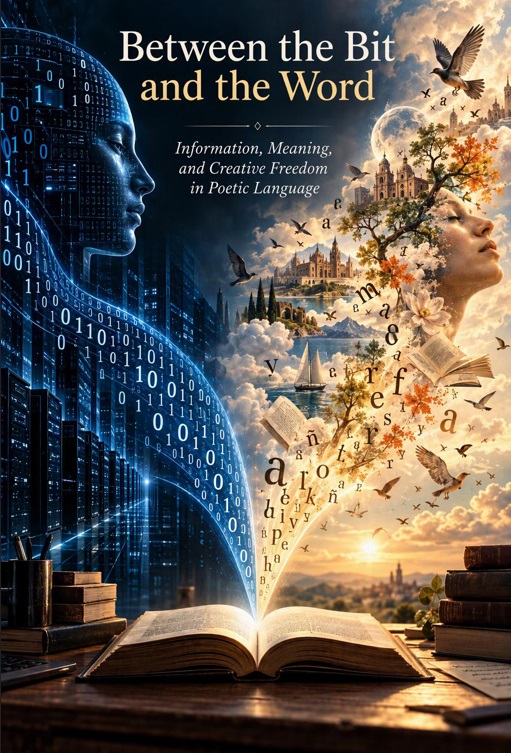
Contemporary computer architecture is founded on an extraordinarily simple principle: the combination of two symbols, 0 and 1. From this elementary duality, increasingly complex systems have been built. The organization of bits into sequences of eight, sixteen, thirty-two, sixty-four, or more positions has made possible the development of programming languages, communication networks, storage systems, and, ultimately, the vast technological ecosystem that today facilitates human interaction. The fact that a digital conversation can take place between two people located in different parts of the planet is a consequence of this virtually inexhaustible combinatorial capacity.
Something similar occurs with language. Spanish possesses a limited set of letters, twenty-seven in its current alphabet, and yet from those few elements it has constructed a lexical universe of remarkable richness. Every word is the result of a specific combination of signs, just as a sequence of bits forms an instruction or a piece of data within a computational system. The analogy, however, soon reaches its limits. While bits acquire value only within a logical operation, words participate in human experience. A word does not merely convey information: it evokes memories, activates emotions, preserves histories, transmits cultures, and opens possibilities for interpretation. Computing processes information; language produces meaning. In this difference lies an essential part of its creative power.
Moreover, we cannot ignore that there are two fundamental structural dimensions that run through any reflection on language: information and meaning. Although they are often treated as equivalents, they belong to different orders. Information consists of the transmission of data organized according to specific rules; its effectiveness depends on the precision with which those data can be encoded, stored, and processed. Meaning, by contrast, emerges when a consciousness interprets what it receives, relates it to prior experience, integrates it into a vision of the world, and attributes value to it. A signal may carry information; a word may contain meaning.
This distinction is decisive. A computer can process immense quantities of information without understanding what it processes. It identifies patterns, executes operations, and establishes correlations, yet remains within the functional universe of data. Human language operates on another plane. Every word is surrounded by a network of cultural, historical, emotional, and symbolic associations that no definition can completely exhaust. For this reason, the same expression acquires different meanings depending on the era, the context, or the sensitivity of the person who receives it. Where information seeks to transmit something precisely, meaning opens a potentially limitless field of interpretations.
If we consider that the dictionary of the Royal Spanish Academy records close to one hundred thousand words and lexical forms, the magnitude of the linguistic field available for literary creation becomes evident. Yet the true breadth of this field does not reside exclusively in the number of existing words. The poet does not merely employ inherited vocabulary; he or she modifies relationships, shifts meanings, establishes unexpected associations, alters semantic hierarchies, and opens new possibilities for reading. A single word can acquire different nuances depending on its context, intention, or the structure that contains it. From this perspective, the expressive potential of language appears difficult to exhaust.
Poetry arises precisely from this capacity to reorganize language. It does not consist merely of describing the world but of producing new ways of perceiving it. When the poet writes, he or she works with familiar materials yet arranges them in a singular manner. The words are the same ones used by the scientist, the merchant, the politician, or the ordinary citizen; nevertheless, the poetic operation transforms their relationships and reveals connections that remained hidden or unnoticed. Poetic creation depends not only on the invention of new content but also on the ability to discover latent meanings within what is already known.
From this perspective, poetry may be understood as one of the most intense manifestations of meaning. While other forms of discourse privilege the efficient transmission of information, the poem explores the plurality of meanings that words can evoke. Its purpose is not simply to communicate something but to expand the horizon of what can be communicated. Where everyday language seeks to reduce ambiguity in order to facilitate exchange, poetry incorporates ambiguity as a source of knowledge and experience. The poem does not close meanings; it multiplies them.
Throughout history, numerous schools, movements, and aesthetic models have emerged. Each has proposed methods, values, and criteria for understanding poetry. Such approaches have enriched literary tradition and provided valuable tools for creation and analysis. Yet none can claim to exhaust the entirety of the poetic phenomenon. Schools are interpretations, not limits; they are possible pathways, not definitive frontiers. The very diversity of literary history demonstrates that poetry always surpasses the frameworks devised to define it.
Human experience constitutes one of the principal sources of poetic creation. Love, sadness, melancholy, joy, abandonment, hope, and uncertainty provide materials that the poet transforms through language. Emotion alone, however, is not enough. Poetry emerges when experience is shaped, organized, and converted into a verbal form capable of transcending individual experience. The poet observes, selects, synthesizes, and reorganizes the elements of his or her environment in order to construct a distinctive vision of the world.
Every form of art involves, to some degree, an interpretation of reality. The writer, poet, painter, or musician begins with stimuli from the external world but does not merely reproduce them mechanically. They transform them through the specific resources of their discipline. To create is to introduce a distance between observed reality and represented reality. In that space of transformation, the work of art comes into being.
For this reason, it is impoverishing to impose rigid limits on poetry. When an aesthetic conception attempts to define conclusively which themes, tones, images, or procedures are legitimate, it restricts a domain whose very nature consists in exploration. Literary history offers countless examples of works that broke conventions and expanded the expressive possibilities of their time. What once appeared inadmissible was eventually incorporated into the cultural heritage of later generations.
If, through the combination of two elementary signs, humanity has built the technological complexity that sustains much of contemporary life, it is even more difficult to conceive limits for an art whose richness depends not only on its vast lexical repertoire but also on the human capacity to generate ever-new meanings from it. Poetry is not a territory defined by doctrines or schools but an open space in which language explores its own possibilities. Theories, manifestos, and literary movements enrich that exploration, but they cannot exhaust it. Every new voice alters the horizon of the possible and demonstrates that poetic creation exceeds any attempt at closure.
The true richness of language does not reside in the number of words it contains but in the capacity of each of them to generate new meanings. Information can be stored, transmitted, and reproduced; meaning, by contrast, is renewed each time a consciousness interprets the world through words. As long as this faculty of transforming experience into meaning exists, language will continue to discover new territories, and poetry will continue to expand its frontiers. Freedom is not a secondary characteristic of poetry: it is its essential condition. Wherever there is a consciousness capable of naming, interpreting, and reorganizing the world, there will remain the inexhaustible possibility of the poem.